Josh Lee Josh Lee
0 Course Enrolled • 0 Course CompletedBiography
Exam H12-811_V2.0 Papers, New H12-811_V2.0 Exam Experience
What's more, part of that Exam-Killer H12-811_V2.0 dumps now are free: https://drive.google.com/open?id=1iITkJm4C6txho-daYSTL8L5fdsQak_5n
We provide three versions to let the clients choose the most suitable equipment on their hands to learn the H12-811_V2.0 exam guide such as the smart phones, the laptops and the tablet computers. We provide the professional staff to reply your problems about our study materials online in the whole day and the timely and periodical update to the clients. So you will definitely feel it is your fortune to buy our H12-811_V2.0 Exam Guide question. If you buy our H12-811_V2.0 exam dump you odds to pass the test will definitely increase greatly. Now we want to introduce you our H12-811_V2.0 study guide in several aspects in detail as follow.
Huawei H12-811_V2.0 Exam Syllabus Topics:
| Topic | Details |
|---|---|
| Topic 1 |
|
| Topic 2 |
|
| Topic 3 |
|
| Topic 4 |
|
| Topic 5 |
|
| Topic 6 |
|
>> Exam H12-811_V2.0 Papers <<
2026 Huawei H12-811_V2.0 Pass-Sure Exam Papers
I believe that you must know Exam-Killer, because it is the website with currently the highest passing rate of H12-811_V2.0 certification exam in the market. You can download a part of H12-811_V2.0 free demo and answers on probation before purchase. After using it, you will find the accuracy rate of our H12-811_V2.0 test training materials is very high. What's more, after buying our H12-811_V2.0 exam dumps, we will provide renewal services freely as long as one year.
Huawei HCIA-Datacom V2.0 Sample Questions (Q43-Q48):
NEW QUESTION # 43
After the root bridge is elected on an STP network, which of the following parameters may be compared by ports on non-root bridge nodes to elect the root port? (Select all that apply)
- A. PID of a port on the local device
- B. Root path cost (RPC)
- C. BID of the device that sends BPDUs
- D. PID of a port on the device that sends BPDUs
Answer: A,B,C,D
Explanation:
On a non-root bridge, the root port is the port that receives the best BPDU toward the root bridge. STP selects the root port by comparing several parameters in order. The first important parameter is the root path cost (RPC) , so option B is correct. If multiple ports have the same RPC, the switch then compares the bridge ID (BID) of the upstream device sending the BPDU, making option C correct. If those are still equal, the switch compares the port ID (PID) of the upstream sending port, so option D is also correct.
If all of those values remain identical from the switch's perspective, the device can finally compare the local port ID to determine which local interface becomes the root port, so option A is also correct. HCIA-Datacom teaches this comparison logic as part of STP election rules. The process ensures deterministic selection of a single root port on every non-root switch. Understanding the comparison sequence is essential for predicting STP topology behavior and for influencing port roles through path cost tuning or bridge-priority adjustments during campus network design and troubleshooting.
NEW QUESTION # 44
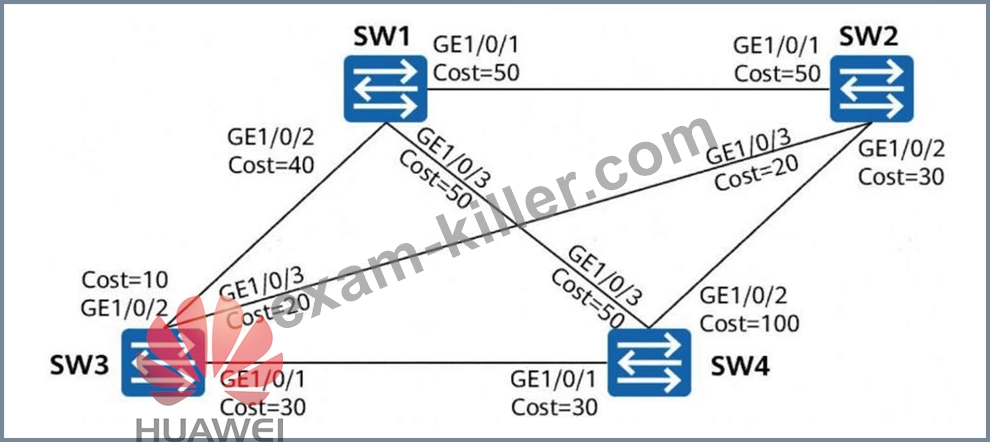
On the switched network shown in the figure, STP is enabled on all devices. SW1 is the root bridge. The port costs are shown in the figure. Other parameters retain the default values. After the network is stable, which of the following paths is used by SW1 to send traffic to SW4?
- A. SW1 # SW2 # SW3 # SW4
- B. SW1 # SW4
- C. SW1 # SW3 # SW4
- D. SW1 # SW2 # SW4
Answer: C
Explanation:
After STP convergence, only ports in the forwarding state participate in active traffic forwarding, while redundant ports may be placed into the blocking or discarding state to eliminate loops. According to the topology and STP role election shown in the question, the valid forwarding path from SW1 to SW4 is SW1 # SW3 # SW4, so option B is correct.
This means that the direct alternative path or the path through SW2 is not the active spanning-tree forwarding path after election and state transition. STP selects paths based on the root bridge, path cost, bridge ID, and port ID. Once the root bridge and port roles are determined, some links remain active and others are blocked to ensure a loop-free Layer 2 topology. HCIA-Datacom emphasizes that the resulting forwarding topology is a tree, not a mesh, even if the physical topology contains redundant links. Understanding the actual forwarding path after STP convergence is important for troubleshooting connectivity, predicting traffic behavior, and verifying whether bridge priority and path-cost settings have produced the intended design outcome in campus switching networks.
NEW QUESTION # 45
In the leader AP networking architecture, the leader AP functions as a WAC and uses the CAPWAP protocol to uniformly manage and configure Fit APs.
- A. FALSE
- B. TRUE
Answer: B
Explanation:
This statement is true . In the leader AP networking architecture, one AP acts as the leader AP , taking on controller-like functions similar to those of a WAC for a small or medium-sized WLAN deployment. It can centrally manage other Fit APs and deliver unified wireless configurations such as SSIDs, security settings, and radio parameters. CAPWAP is used for management and control communication between the leader AP and the managed Fit APs.
This architecture is useful in scenarios where deploying a dedicated WAC is unnecessary or uneconomical, but centralized AP management is still desired. It provides a balance between simplicity and control and is commonly used in branch offices, small campuses, and similar environments. HCIA-Datacom explains leader AP networking as an intermediate solution between fully autonomous AP deployment and full WAC + Fit AP enterprise architecture. The key point is that the leader AP behaves as the management node for the other APs and enables unified configuration and control. Therefore, the statement correctly describes both the role of the leader AP and the use of CAPWAP in this architecture.
NEW QUESTION # 46
During VLAN planning for a campus network, VLAN IDs for different service types must be allocated consecutively, without redundancy, to prevent omissions in future allocations.
- A. TRUE
- B. FALSE
Answer: B
Explanation:
This statement is false . In campus network VLAN planning, VLAN IDs do not have to be allocated strictly consecutively without any gaps. In fact, leaving some reserved VLAN IDs is often a practical and recommended design approach. VLAN planning should focus on clarity, scalability, maintainability, and service separation , rather than on forcing all VLAN IDs to be contiguous.
For example, an administrator may reserve certain VLAN ranges for user access, voice services, management, wireless services, guest access, future expansion, or specific departments. Such structured planning makes later network expansion easier and reduces the risk of service conflicts or disruptive renumbering. HCIA- Datacom emphasizes that good campus network planning should consider current requirements and future growth. Consecutive allocation may look tidy at first, but it can actually reduce flexibility and make later additions more difficult. Therefore, the idea that VLAN IDs must be assigned consecutively without redundancy to avoid omissions is not a correct design principle. Reasonable reservation and categorized allocation are often more beneficial in real enterprise campus networks.
NEW QUESTION # 47
R1 has four static routes, each of which has a reachable next hop. Given the following static route configuration, what is the next hop of the route to 20.0.0.0/30 in R1's routing table?
[R1] ip route-static 20.0.0.0 30 10.1.1.2
[R1] ip route-static 20.0.0.0 30 10.1.2.2 preference 7 0
[R1] ip route-static 20.0.0.0 30 10.1.3.2 preference 50
[R1] ip route-static 20.0.0.0 30 10.1.4.2 preference 100
- A. 10.1.4.2
- B. 10.1.3.2
- C. 10.1.2.2
- D. 10.1.1.2
Answer: B
Explanation:
When multiple static routes exist to the same destination prefix and all next hops are reachable, the device selects the route with the highest priority , which on Huawei devices means the lowest preference value . In this question, all four static routes point to the same destination network 20.0.0.0/30, but they have different preference values.
The route through 10.1.1.2 uses the default static route preference , which is 60 on Huawei devices. The route through 10.1.2.2 has a preference of 70 , the route through 10.1.3.2 has a preference of 50 , and the route through 10.1.4.2 has a preference of 100 . Since 50 is the lowest value among them, the route via 10.1.3.2 is preferred and installed in the routing table. Therefore, option D is correct. HCIA-Datacom emphasizes that when prefix length is identical, route preference determines which route is active. This principle is widely used in route backup design, where primary and floating backup static routes are configured using different preference values to control failover behavior.
NEW QUESTION # 48
......
Your life will take place great changes after obtaining the H12-811_V2.0 certificate. Many companies like to employ versatile and comprehensive talents. What you have learnt on our H12-811_V2.0 preparation prep will meet their requirements. So you will finally stand out from a group of candidates and get the desirable job. At the same time, what you have learned from our H12-811_V2.0 Exam Questions are the latest information in the field, so that you can obtain more skills to enhance your capacity.
New H12-811_V2.0 Exam Experience: https://www.exam-killer.com/H12-811_V2.0-valid-questions.html
- Free H12-811_V2.0 Vce Dumps 🖕 Reliable H12-811_V2.0 Learning Materials 🔓 H12-811_V2.0 Trustworthy Exam Torrent 👜 Simply search for ➡ H12-811_V2.0 ️⬅️ for free download on ▷ www.prepawaypdf.com ◁ 🍎H12-811_V2.0 Certificate Exam
- Exam H12-811_V2.0 Papers 100% Pass | High-quality New H12-811_V2.0 Exam Experience: HCIA-Datacom V2.0 ⏮ Download ⮆ H12-811_V2.0 ⮄ for free by simply entering 【 www.pdfvce.com 】 website 📹H12-811_V2.0 Latest Braindumps
- Huawei Exam H12-811_V2.0 Papers Exam Pass Once Try | New H12-811_V2.0 Exam Experience 🤚 Download ✔ H12-811_V2.0 ️✔️ for free by simply searching on ⇛ www.verifieddumps.com ⇚ 🎮Exam H12-811_V2.0 Question
- Exam H12-811_V2.0 Papers 100% Pass | High-quality New H12-811_V2.0 Exam Experience: HCIA-Datacom V2.0 🖼 Enter ( www.pdfvce.com ) and search for “ H12-811_V2.0 ” to download for free 😄H12-811_V2.0 Certificate Exam
- Professional Huawei - H12-811_V2.0 - Exam HCIA-Datacom V2.0 Papers 😒 Search on ⇛ www.examcollectionpass.com ⇚ for 《 H12-811_V2.0 》 to obtain exam materials for free download 🌺Reliable H12-811_V2.0 Test Notes
- Reliable Exam H12-811_V2.0 Papers - Pass H12-811_V2.0 Exam 🔥 Open website 《 www.pdfvce.com 》 and search for ▛ H12-811_V2.0 ▟ for free download 🛹New H12-811_V2.0 Braindumps
- Exam H12-811_V2.0 Question 💕 New H12-811_V2.0 Braindumps 🧙 H12-811_V2.0 Exam Fees 🔚 Search for ➥ H12-811_V2.0 🡄 and download exam materials for free through [ www.testkingpass.com ] 📆Reliable H12-811_V2.0 Test Notes
- HCIA-Datacom V2.0 valid practice questions - H12-811_V2.0 exam pdf vce - HCIA-Datacom V2.0 test training simulator 📹 Open ⇛ www.pdfvce.com ⇚ and search for { H12-811_V2.0 } to download exam materials for free 🥔New H12-811_V2.0 Braindumps
- High-quality Exam H12-811_V2.0 Papers Spend Your Little Time and Energy to Pass H12-811_V2.0: HCIA-Datacom V2.0 exam 🥁 Download ➠ H12-811_V2.0 🠰 for free by simply searching on ( www.practicevce.com ) ⤵New H12-811_V2.0 Braindumps
- High-quality Exam H12-811_V2.0 Papers Spend Your Little Time and Energy to Pass H12-811_V2.0: HCIA-Datacom V2.0 exam 🪔 Simply search for ⏩ H12-811_V2.0 ⏪ for free download on ➽ www.pdfvce.com 🢪 📆Latest H12-811_V2.0 Test Materials
- H12-811_V2.0 Exam Fees 👵 Exam H12-811_V2.0 Question 🤚 H12-811_V2.0 Latest Braindumps 🌆 Search for 【 H12-811_V2.0 】 and easily obtain a free download on ➠ www.pdfdumps.com 🠰 📿Valid H12-811_V2.0 Study Notes
- jessesvqs351538.blogpayz.com, bookmarksystem.com, leaugon107616.losblogos.com, joshosvy433907.blogdosaga.com, haariseufs908742.tkzblog.com, siobhanfymk998707.blogs100.com, isocialfans.com, georgiayvas249593.corpfinwiki.com, phoenixoxyv928326.wikidank.com, networkbookmarks.com, Disposable vapes
BONUS!!! Download part of Exam-Killer H12-811_V2.0 dumps for free: https://drive.google.com/open?id=1iITkJm4C6txho-daYSTL8L5fdsQak_5n